Hair thinning, a receding hairline, or visible bald patches can make people wonder whether a hair transplant is the right long-term solution. FUE Hair Transplant: Procedure, Benefits, and Results are important to understand before deciding on treatment because successful hair restoration involves much more than simply moving hair from one part of the scalp to …

Hair thinning, a receding hairline, or visible bald patches can make people wonder whether a hair transplant is the right long-term solution. FUE Hair Transplant: Procedure, Benefits, and Results are important to understand before deciding on treatment because successful hair restoration involves much more than simply moving hair from one part of the scalp to another.
Follicular Unit Extraction (FUE) is a minimally invasive hair restoration technique in which individual follicular units are removed from a donor area and carefully transplanted into areas affected by hair loss. When properly planned and performed, FUE Hair Transplant in Islamabad can create natural-looking coverage without the linear scar associated with traditional strip surgery.
What Is an FUE Hair Transplant?
FUE involves harvesting individual follicular units, which usually contain one to four hairs, from a suitable donor area, most commonly the back or sides of the scalp. Small punches are used to remove the grafts before they are prepared and placed into tiny recipient sites in areas of thinning or baldness.
The objective isn’t simply to add as many grafts as possible. A natural result depends on factors such as hairline design, graft selection, placement angle, direction, density, and preservation of the donor area.
This is why a proper medical assessment is essential before choosing FUE Hair Transplant in Islamabad or elsewhere.
How Does the FUE Procedure Work?
Although the exact technique varies according to the patient’s hair loss pattern and the surgeon’s approach, the process generally involves several stages.
1. Consultation and Hair Assessment
The doctor examines the scalp, donor area, hair density, hair-loss pattern, and overall health. The likely cause and stability of hair loss are also considered.
Patients may be advised to manage active or progressive hair loss before surgery. The American Academy of Dermatology notes that suitable candidates need adequate healthy donor hair and the ability to grow hair in the recipient area.
2. Hairline and Graft Planning
The hairline is designed according to facial proportions, age, existing hair pattern, donor availability, and realistic long-term expectations.
This stage is particularly important. Creating an overly low or dense hairline may use donor follicles that could be needed later if natural hair loss continues.
3. Follicle Extraction
After local anesthesia is administered, individual follicular units are carefully harvested from the donor region using a small punch.
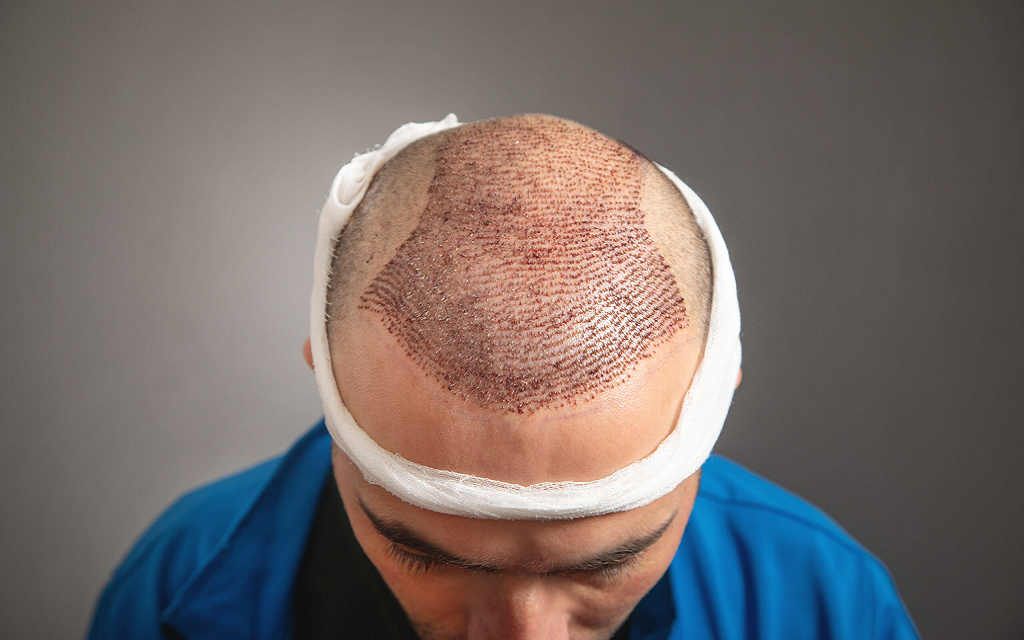
Unlike FUT, FUE doesn’t require removing a strip of scalp. Instead, the donor area contains numerous tiny extraction sites that heal over time.
4. Graft Preparation
The extracted follicles are examined and prepared for transplantation. Their handling matters because unnecessary trauma can affect graft quality.
5. Graft Placement
The prepared grafts are inserted into recipient sites according to the planned hairline, direction, angle, and density.
Experienced hair-restoration teams focus on making transplanted hair blend with existing growth rather than creating an obviously transplanted appearance.
Benefits of FUE Hair Transplant
FUE has become widely used because it offers several practical advantages:
- No linear strip scar: Unlike FUT, FUE doesn’t involve removing a continuous strip of scalp.
- Natural-looking restoration: Individual graft placement allows careful control over hair direction and distribution.
- Minimally invasive approach: The procedure uses small extraction sites rather than a large surgical incision.
- Shorter visible recovery: Many patients can resume routine activities relatively quickly, although recovery varies.
- Long-term hair growth: Transplanted follicles from a suitable donor area can provide lasting growth.
- Flexible styling: The absence of a linear scar can be particularly useful for people who prefer shorter hairstyles.
However, FUE isn’t completely scar-free. Tiny circular scars can remain at extraction points, and excessive harvesting can compromise the appearance of the donor area.
Who Is a Good Candidate for FUE?
FUE may be considered for people experiencing pattern hair loss, receding hairlines, crown thinning, or selected forms of other hair loss where transplantation is medically appropriate.
A suitable candidate generally needs:
- A sufficiently healthy donor area
- Realistic expectations about density and coverage
- A recipient area capable of supporting transplanted follicles
- A stable or appropriately managed pattern of hair loss
- Good general health for the procedure
Not everyone with hair loss needs a transplant. If hair loss is sudden, unexplained, inflammatory, or related to an underlying medical problem, the cause should be investigated before surgery.
When FUE May Not Be the Right Choice
A transplant may not be appropriate when there isn’t enough donor hair to achieve the desired coverage. Younger patients with rapidly progressing hair loss may also need a longer-term treatment strategy rather than immediate surgery.
Certain medical conditions, scalp disorders, uncontrolled hair loss, or unrealistic expectations can also affect candidacy.
A responsible consultation should explain not only what can be achieved but also what cannot.
FUE Hair Transplant Results: What Should You Expect?
One of the biggest misconceptions is expecting immediate hair growth after transplantation.
The transplanted hairs commonly shed during the early weeks following surgery. This can be alarming, but temporary shedding is a normal part of the process. New growth generally develops gradually, with noticeable improvement often occurring over several months. The AAD reports that many patients see results around six to nine months, while some may require up to 12 months.
A simplified timeline may look like this:
- First week: Redness, small scabs, or mild swelling may occur.
- Weeks 2–8: Transplanted hairs may shed.
- Around 3–4 months: Early new growth may become visible.
- 6–9 months: Density and coverage become more noticeable.
- Around 12 months: The result can be substantially more developed.
Individual growth rates vary, so before-and-after photographs should always be interpreted in the context of the patient’s starting condition, graft count, hair characteristics, and time since treatment.
FUE Aftercare and Recovery Tips
Following post-procedure instructions carefully can help protect the newly transplanted grafts.
Your doctor may recommend:
- Keeping the recipient area protected during the initial healing period
- Washing the scalp according to the clinic’s instructions
- Avoiding scratching, rubbing, or picking at scabs
- Temporarily avoiding strenuous exercise
- Protecting the scalp from excessive sun exposure
- Taking prescribed medications exactly as directed
- Attending scheduled follow-up appointments
Recovery isn’t identical for everyone. Your doctor should give you individualized instructions based on how your scalp responds.
Common Mistakes People Make
Choosing a clinic based solely on price is one of the biggest mistakes in hair transplantation. The number of grafts quoted isn’t enough to determine whether a treatment plan is appropriate.
Other mistakes include:
- Expecting a completely full head of hair regardless of donor supply
- Choosing an unrealistically low hairline
- Ignoring continuing natural hair loss
- Comparing results taken at different stages of recovery
- Assuming FUE automatically guarantees a perfect result
- Failing to ask who actually performs the extraction and implantation
ISHRS specifically emphasizes that FUE is a physician-driven surgical procedure and highlights concerns about unlicensed technicians performing key surgical steps.
What Does FUE Hair Transplant Cost?
There isn’t one universal price for FUE. Cost can vary according to the number of grafts required, extent of hair loss, desired density, case complexity, medical team, and facility.
For example, Estheticare’s current FUE information states that pricing starts from PKR 180,000, while noting that the final cost depends on graft requirements, coverage, case complexity, and specialist expertise.
For anyone considering FUE Hair Transplant in Islamabad, an individualized consultation is more useful than relying on a generic advertised price.
FUE vs. FUT: What’s the Difference?
| Feature | FUE | FUT |
| Harvesting method | Individual follicular units | Strip of scalp |
| Linear scar | No | Yes |
| Extraction sites | Small individual sites | One surgical strip |
| Recovery | Generally less invasive | More surgical recovery |
| Suitable for short hairstyles | Often advantageous | Linear scar may be visible |
| Planning | Depends heavily on donor management | Also requires careful donor planning |
Neither technique is automatically suitable for every patient. The appropriate method depends on donor characteristics, hair-loss pattern, goals, and the surgeon’s assessment.
Frequently Asked Questions
Is FUE Hair Transplant Safe?
FUE is a surgical procedure and, like other procedures, carries potential risks. Temporary redness, swelling, itching, scabbing, infection, poor graft growth, or an unnatural appearance can occur. Choosing qualified medical professionals and following aftercare instructions can help reduce avoidable risks.
How Long Do FUE Results Last?
Hair transplanted from a suitable donor region can provide long-lasting growth. However, surrounding natural hair may continue thinning. This is why long-term hair-loss management can remain important even after transplantation.
Is FUE Painful?
FUE is generally performed under local anesthesia, so patients should not experience significant pain during the surgical portion. Some tenderness, tightness, or discomfort can occur afterward.
When Can I See the Final Result?
Hair restoration takes time. Early growth may become visible after several months, while fuller results commonly develop around 9–12 months.
Is FUE Worth It?
Whether FUE is worthwhile depends on your hair-loss pattern, donor supply, expectations, and the quality of the treatment plan. A good candidate can achieve meaningful, natural-looking restoration, but transplantation cannot recreate unlimited hair density.
What Should I Ask Before Choosing a Clinic?
Ask who will perform the surgical steps, how many grafts are recommended and why, whether your donor area can support the plan, what results are realistic, what complications are possible, and what follow-up care is included.
Final Thoughts
FUE can be an effective option for restoring hair when the patient is properly selected, and the procedure is carefully planned. Its main advantages include individual follicle extraction, no linear strip scar, natural hair placement, and the potential for long-lasting growth.
The most important decision isn’t simply finding a clinic offering FUE. It’s understanding your cause of hair loss, donor capacity, realistic density, long-term needs, and who will perform the procedure. If you’re considering FUE Hair Transplant in Islamabad, Estheticare Group can be one of the clinics to discuss your individual hair-loss pattern and treatment expectations with during a professional consultation.
A well-planned transplant should be viewed as a long-term hair-restoration strategy, not a quick fix, and realistic expectations are an important part of achieving a satisfying result.
Book an Appointment
It’s easy and free!
Tags:FUE Hair Transplant